The 15 Rules My AI Agents Work Under, and Why I Am Publishing Them
Before I let AI agents draft, send or spend anything for my business, I wrote down the rules they work under. There are 15. I am publishing one every weekday in a free library, and this post explains why.
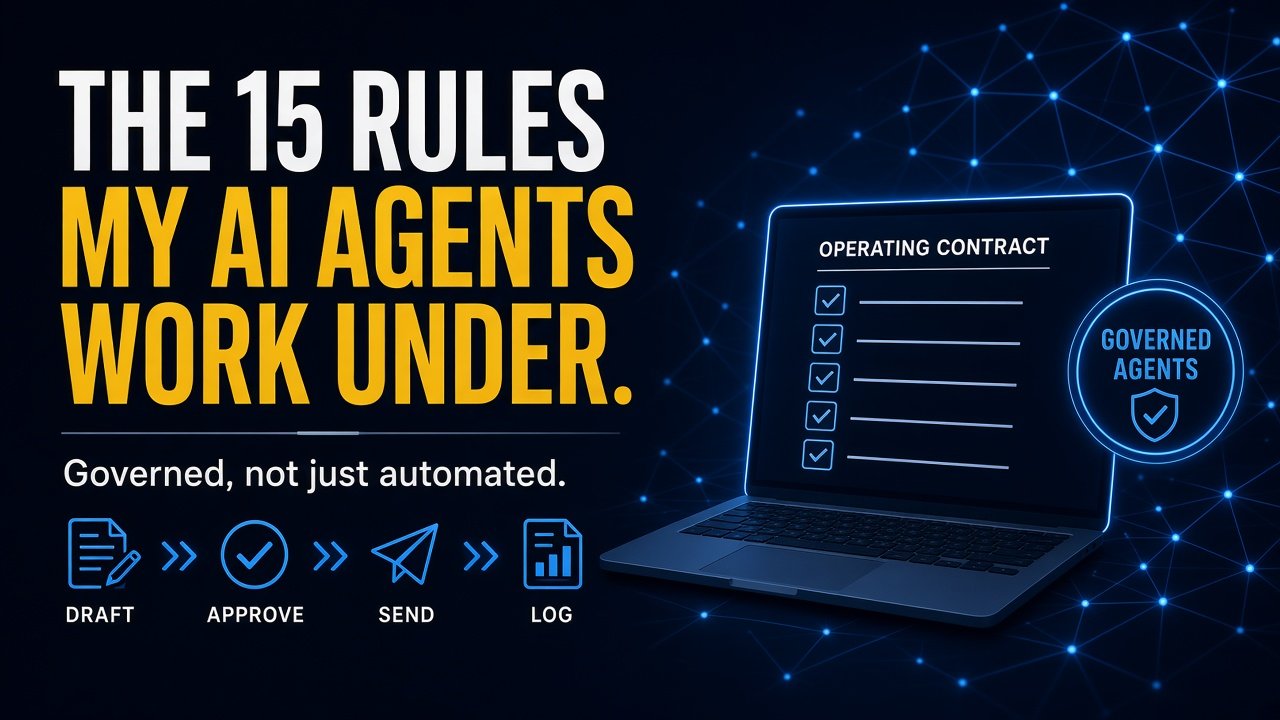
My AI agents work under a written contract of 15 rules. It covers what they may do on their own, what they must stop and ask me about, and what they may never do at all. I wrote it before I let any agent draft, send or spend on behalf of my business, and I am now publishing the rules one at a time, every weekday, in a free library.
I have built software for more than 30 years. In that time I have learned that most systems do not fail because someone was careless on the day. They fail because nobody decided in advance what the system was allowed to do. AI agents make that gap bigger, because they act quickly, they sound confident, and they do exactly what their setup allows, not what you meant.
Why write the rules down at all?
When you work alone, the rules live in your head. That works until you hand part of the work to something that cannot read your head.
An agent that writes outreach emails will, at some point, be in a position to send one. An agent with access to a paid tool will, at some point, be able to run up a bill. An agent that reads your inbox will, at some point, read an email that tells it to do something. If the answer to "what happens then?" is not written down, the answer is whatever the default happens to be.
So I wrote the answers down. The result is what I call the Agent Operating Contract. Every agent loads it at the start of every session, from a file, never from chat history. An agent that cannot comply does not run.
What is actually in the contract?
The 15 rules are short. A few of them carry most of the weight.
Three tiers of action. Every action is either Act (do it and log it), Notify (do it and tell me in the daily brief), or Approve (stop and ask me with the exact content). If an action is not clearly in the first two, it is Approve.
Approval is bound to content. When I approve something, I approve that exact text, recipient and action. If one word changes, the approval is gone and the new version needs its own.
The founder approves, nobody else. No agent can approve another agent's request. There is no manager role. There is one human.
Draft and send are separate. The agent that writes something cannot send it, and the agent that sends cannot change it.
Budgets are hard limits. Every agent has a per-task, monthly and daily action budget. Hitting any limit stops it.
The rest cover loops that must end, independent checks before a task counts as done, no automatic retries on anything irreversible, contact limits, compliance lines, instructions hidden in content, credentials, reports, installing new agents, and what wins when two instructions conflict. The last rule is simple: the contract wins.
None of this is clever. That is the point. Each rule closes one specific way an agent can do something you did not intend.
Why give it away?
Because I think most small business owners who try agents will skip this step, and not because they do not care. They skip it because nobody shows them what the rules look like in practice.
So the library at governed.master22solutions.com takes one rule per weekday, in contract order. Each entry has three parts: what the rule prevents, the rule itself in one sentence, and a policy snippet you can adapt for your own setup. It started on October 13 with three tiers of action, and it works through all 15.
I am deliberate about what I put in there. Every entry comes from the contract and the agent packages in my playbook. I am not inventing horror stories to make a point. If a rule is worth having, the reason should hold up on its own.
What does this mean if you are thinking about agents?
You do not need my contract to start. You do need some version of it. Before an agent touches your business, I would answer three questions in writing:
- What can it do without asking you?
- What must it stop and show you first, word for word?
- What can it never do, no matter what it reads or who seems to be asking?
If you can answer those three, you have done the part most people skip. If you cannot, the agent will answer them for you, one action at a time.
This is also how I build agents for clients. Governance is not a feature I add at the end. It is the first conversation.
Where to go from here
Read the free library and take whatever rules are useful to you: governed.master22solutions.com.
If you want the full 15-rule contract and all 12 agent packages in one place, they are in my playbook, The Governed One-Person Company. 30% off with code LAUNCH: paulrodturner.gumroad.com/l/governed-one-person-company/LAUNCH.
And if you would rather have a governed agent built and run for you, book a Founder Alignment Session and we will start with the rules.
FAQ: Common Questions
Q: What is the Governed Agents library?
A: It is a free library at governed.master22solutions.com. Each entry covers one rule from my Agent Operating Contract: what the rule prevents, the rule in one sentence, and a policy snippet you can adapt. I publish one rule every weekday, in contract order.
Q: Do these rules need special software?
A: No. The rules are written in plain language with policy snippets in JSON or checklist form. Your own agent setup still has to enforce them. A written rule does not apply itself.
Q: Where can I get the full contract and the agent packages?
A: The full 15-rule contract and 12 agent packages are in my playbook, The Governed One-Person Company, on Gumroad. The code LAUNCH takes 30% off.